There’s really nothing else quite like King of the Hill, though plenty of shows come close in one way or another. Mike Judge’s animated sitcom about propane salesman Hank Hill, his substitute-teacher wife Peggy, and their oddball son Bobby is unusual for how firmly it stays rooted in realism, even while its Texas cast can seem stranger than fiction. It’s a mix that’s difficult to duplicate.
If Hank were a live-action character, he wouldn’t be the kind of guy cast as a leading man very often. He’s funny mostly by accident, not especially flashy, and not built like a traditional TV heartthrob. His drinking buddies are even more peculiar: conspiracy-minded exterminator Dale, struggling Bill, and the mumbling Boomhauer. Still, there are a number of live-action and animated shows that capture a similar spirit.
Arlen, Texas, may be fictional, but Judge and Greg Daniels gave it a vivid sense of place that feels real. If King of the Hill hooked you, what other series deliver the same blend of clueless dads, strange kids, richly drawn communities, and sharp humor? Here are some strong contenders.
Beavis and Butt-Head
If you enjoy one Mike Judge cartoon, there’s a good chance the earlier one will work for you too, even if it’s far more cynical. Beavis and Butt-Head is also set in Texas, but instead of Arlen’s comparatively ordinary world, the title characters live in a grim, joyless suburb called Highland, where nearly everyone is self-involved, oblivious, and pretty dim.
Fans of Judge’s talent for giving even absurd characters a trace of humanity will recognize familiar voices and ideas. Butt-Head helped inspire Bobby’s delinquent classmate Dooley, while Hank Hill’s voice is shared with Tom Anderson, the near-sighted Korean War veteran who never remembers the boys as the ones who trashed his house after being hired for odd jobs. Of course, all of them are voiced by Judge.
The show defined a generation with its crude simplicity. Its characters’ urges to break things, blast music, and “score” are both mocking and strangely relatable, and their reactions to music videos reduce criticism to its barest form. Now middle-aged, they also satirize the emptiness and distrust that came to define their generation.
The Goode Family
After succeeding with an animated Republican Texas family in King of the Hill, Mike Judge tried the opposite with The Goode Family, which centers on California liberals. Audiences didn’t respond as well, and the series ended after 13 episodes. Even so, fans of Judge should still consider it on DVD or streaming.
It is almost the mirror image of King of the Hill, but it comes from the same creative voice. Instead of drawing on the Mr. Anderson side of Beavis and Butt-Head, Judge channels the hippie streak of David Van Driessen into Gerald Goode, a fiercely politically correct environmentalist professor whose children are a little more practical.
What Gerald Goode and Hank Hill share, beyond Judge’s voice, is a love of having things their own way and a low tolerance for irritation. Judge remains sharp at identifying what deserves ridicule. Making fun of the self-righteous is harder than mocking fools, but this series does exactly that, perhaps a little too effectively for its intended audience.
The Simpsons
The Simpsons is Fox’s first great animated family, and King of the Hill is arguably its second. The two central families are not especially alike—Hank is actually good at his job, and Bobby tries to stay out of trouble—but both shows share a love of large ensembles built around eccentric supporting players. Arlen and Springfield may not exist, yet both feel fully inhabited.
From a drunken clown and an aging sea captain to a villainous boss, odd mascots, anxious gangsters, a deranged groundskeeper, miserable teachers, and caricatured restaurateurs, Springfield has become a showcase for unforgettable oddballs. Bart and Homer once carried the show, but now almost any of the town’s many strange residents can anchor an episode. Like the people we know in real life, these cartoon characters feel exaggerated only slightly, which is part of the joke.
The Drew Carey Show
Though it bears one man’s name, The Drew Carey Show is really an ensemble comedy built around four likable slacker friends who hope for more than dead-end jobs. Drew, Lewis, Oswald, and Kate live in actual Cleveland and try to build a future with their homemade caffeinated Buzz Beer while dealing with ordinary work life. Drew, in particular, is tormented by the overdone Mimi and his erratic English boss Mr. Wick, who is just as unstable as Buck Strickland from King of the Hill.
The show’s central four resemble Hank, Dale, Bill, and Boomhauer in their group dynamic, though the comparison gets looser once Drew and Kate become romantically involved. What sets the series apart is its willingness to veer into the absurd, with characters suddenly launching into musical numbers or bizarre game-night antics. Lewis and Oswald are not merely dim; they’re genuinely strange, which keeps Drew on his toes and gives the show a lot of unpredictable energy.
Whose Line Is It Anyway? (U.S. Version)
On Whose Line Is It Anyway?, Drew Carey oversees a very different kind of loose, oddball foursome, with Ryan Stiles as the main link to The Drew Carey Show. On paper, it looks nothing like a Texas-set animated sitcom. But the chemistry of four friends teasing one another and improvising together gives it a similar feel.
The regular group often includes Colin Mochrie, Ryan Stiles, Wayne Brady, and Greg Proops. Mochrie, like Bill on King of the Hill, sometimes leans into the image of the sad bald guy; Proops can seem as if he overthinks everything like Dale; Brady is the smooth ladies’ man; and Stiles is the most grounded, if also the most physically expressive.
The games lead to situations even more outlandish than most cartoons would dare, but the performers usually bring things back together with an old-fashioned hoedown or Irish drinking song. The made-up phrases replace the original catchphrases, but the friendships behind the chaos always feel genuine.
Married... with Children
High-school sports stars do not always go on to glory. Many simply marry, have a child or two, and end up in sales. That is the path taken by Al Bundy and Hank Hill, both of whom were standout athletes in their youth before real life caught up with them. Hank was injured, while Al got his girlfriend pregnant. Each became the center of a sitcom that put a twist on the traditional family-comedy formula.
Married... with Children was designed as the opposite of The Cosby Show, gleefully blowing up the usual model of lessons learned, emotional breakthroughs, and warm group hugs. At its core, Al wants peace, quiet, and to keep the money he earns, usually for beer and strippers. But his wife Peg and his kids Kelly and Bud constantly get in the way, making his life as miserable as possible.
Al Bundy’s life sometimes becomes almost surreal in its awfulness, but the show works because it feels more honest than most about how family can be exhausting.
Bob's Burgers
Bob Belcher and Hank Hill are not identical, but they share a lot. Bob depends on grills to make his burgers, while Hank sells them in the form of propane accessories. Both men know how to tolerate their wives and the way those wives indulge their strange children. Bobby would probably fit right in with Tina, Gene, and Louise, all of them proudly embracing their weirdness together.
What gives Bob’s Burgers its appeal is its warmth. The kids are unusual, from Louise’s bunny ears to Tina’s zombie obsession, and the animation style stands apart from almost everything else on television. But the show’s heart makes it easy to connect with. Even the most obvious quirks, like female characters voiced by male actors, work because the performances are so sincere. Through it all, Bob’s deadpan attitude feels deeply familiar: just trying to survive the day with a shrug and a steady sense of humor.
King of Queens
Hank Hill and Doug Heffernan do not just share a monarch-themed title. They are also both ordinary, slightly overweight middle-class men with three close drinking buddies and wives who may be smarter, though hardly perfect themselves.
American politics and old salsa commercials often frame Texas and New York as completely different worlds, but The King of Queens suggests the two states have more in common than people think. Both sets of characters care about food, sports, drinks, and spouses they may also fear a little.
Doug and Carrie stand apart from other TV couples because they are newly married and have no children. Instead, they share a house with Carrie’s father Arthur, who lives in the basement and creates a different kind of generational comedy. After Jerry Stiller’s death in 2020, Kevin James said he would not consider a reboot, underscoring how central Stiller was to the show.
Blue Collar TV
The regulars on Blue Collar TV—Jeff Foxworthy, Bill Engvall, and Larry the Cable Guy—along with frequent guest Ron White, form a group that feels like a real-world version of Hank and his alley friends. The only catch is that Larry the Cable Guy is really a persona created by Nebraska comedian Dan Whitney, whose actual accent is not Southern.
As a sketch series, Blue Collar TV is more episodic than King of the Hill, but creatively the two come from similar territory. Both poke fun at rural and Southern stereotypes, yet they do it from a place of affection and self-recognition. The joke is not about outsiders mocking “rubes”; it is about insiders joking about their own people, knowing they are included in the punchline.
The trio is also stronger together than apart. When Engvall and Foxworthy were given separate sitcoms, they were fairly ordinary. In the sketch format, their competition to outdo one another brings out their strangest and funniest instincts.
Home Improvement
If anyone on TV seems as likely as Hank Hill to love propane tanks, it is Tim “The Toolman” Taylor. With his signature “More power!” slogan, the host of Tool Time turns routine repair demos into increasingly wild stunts, which almost always end badly. He is like a live-action Charlie Brown, except he is also the one setting up the disaster.
Tim Allen makes himself the center of attention, but he is also the butt of the joke. Other characters continually outdo him, whether it is Al doing the work better, Jill handling the kids with more empathy, or the wise neighbor Wilson, who is usually the smartest person in the room.
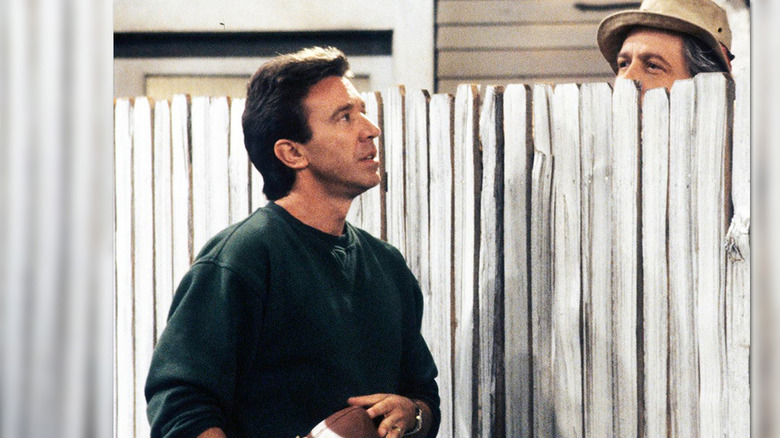
Tim could probably learn a few things about proper tool use from Hank Hill, though there is little reason to think he would listen.
Major Dad
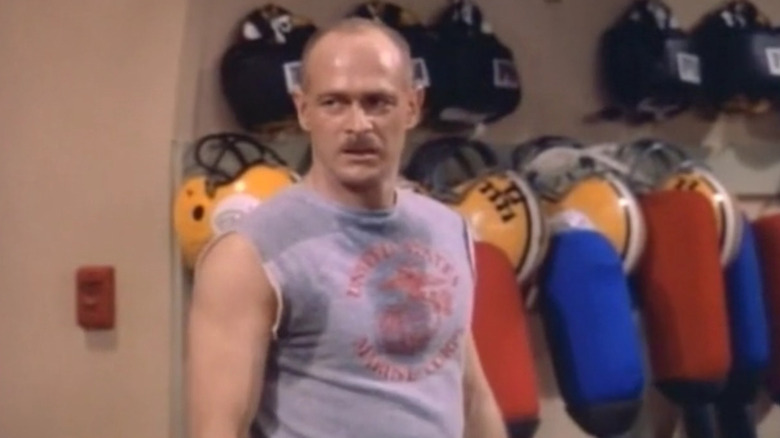
Marine Major John D. McGillis has nearly as hard a time being a sensitive father figure as Hank Hill does, with the extra complication of trying to parent three stepdaughters. He can issue commands when he is frustrated, but getting the girls to follow them is another matter entirely. He is also not always knowledgeable about feminine hygiene, which recalls the King of the Hill storyline in which Hank babysits Connie during her period.
Sometimes the traditional man is actually the one who understands what is going on, and the seemingly more perceptive wife is the one who overcomplicates things. More often, though, the kids know best. Gerald McRaney plays the role with a careful balance of toughness and sensitivity, giving the character the authority of a military man while still making him look overwhelmed by life in a household dominated by women.
The Office (U.K. Version)
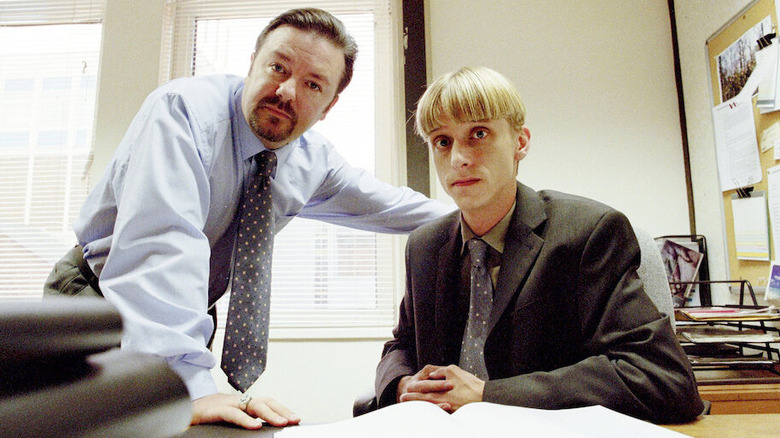
David Brent and Hank Hill are driven by different impulses, but both are clueless supervisors who are less respected than they believe at utterly dull workplaces. David wants to be the relaxed, cool boss who breaks the rules; Hank is rigid and expects to be admired for following them. In neither case are the boss or the employees especially impressed.
The American version of The Office treats the workplace as ordinary. The British original makes it feel bleak, from the grim opening music to the unhappy-looking office exterior in miserable weather. Right away, it suggests there is no escape into a better life; all anyone can do is pass the time by playing jokes on coworkers. Michael Scott seems oddly comfortable with mediocrity, while David Brent seems desperate to prove he matters.
American sitcoms often encourage viewers to find joy in family life when work is dull. British comedies like The Office focus on how draining work can be and, by contrast, how fortunate the viewer may be.
All in the Family
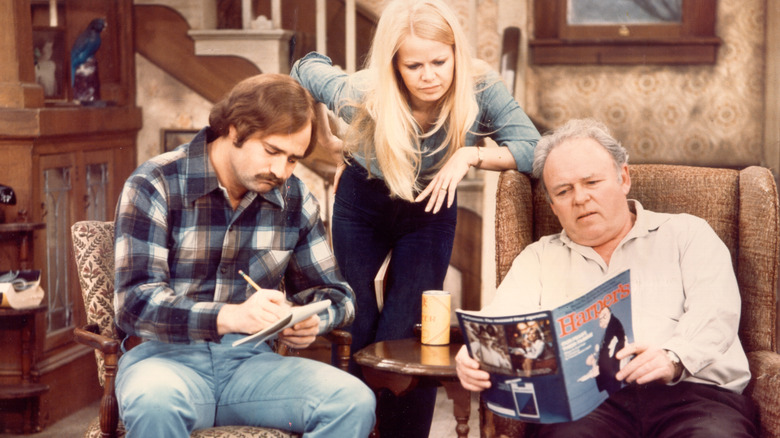
If Hank Hill is a sensible centrist, Archie Bunker would likely be much farther to the right. Television’s most infamous bigot father is closer to Hank’s own father, Cotton Hill: an angry, sexist war veteran who has little patience for anyone. Archie and Cotton might vote the same way, but Archie still resembles Hank in one important respect—he genuinely cares about his family, even when they argue loudly and often.
Archie may clash constantly with his daughter Gloria over feminism and marriage choices, but when it counts, he will defend her. His views are awful, and the show never asks viewers to agree with him, but he is not a complete monster. People sometimes say the series could not be made now because of its language, but the real fantasy today may be the idea of a deeply flawed loved one and the family members who push back against him still managing to coexist.
And then there is Edith, who is smarter than she sounds. Her shrill voice often nudges Archie into moments where he is forced to show some actual affection.
American Dad
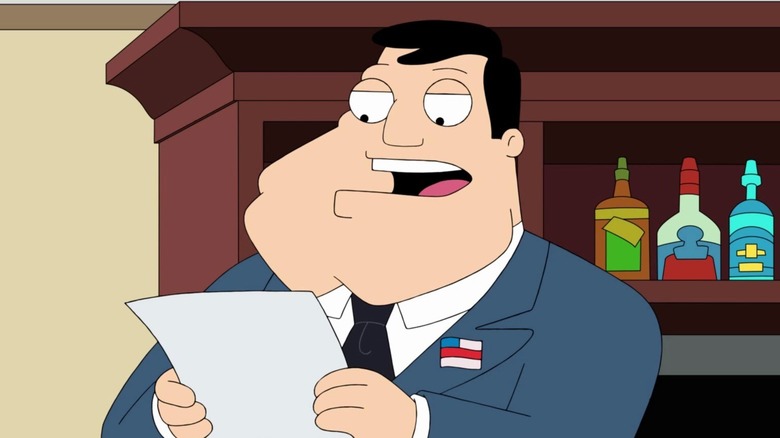
Stan Smith from American Dad would probably be admired in Arlen for his strong jaw, overt patriotism, and shoot-first worldview. Dale Gribble would likely be eager to be his best friend if Stan would allow it, and their conversations would probably confirm all of Dale’s conspiracy theories about aliens and the CIA.
Family Guy was Seth MacFarlane’s first major take on the basic family sitcom. American Dad pushes even further, imagining a father who works for the CIA and is just as narcissistic and macho as the worst stereotypes suggest. His daughter is a hippie for contrast, and the family’s bizarre alien uncle regularly commits massive crimes. Unlike Family Guy, which often relies on pop-culture riffing, American Dad builds its own mythology around action-driven stories.
Could Stan Smith ever meet Hank Hill? Executive producer Richard Appel has said he is open to crossovers with shows that have different styles, so it is possible.
Family Guy
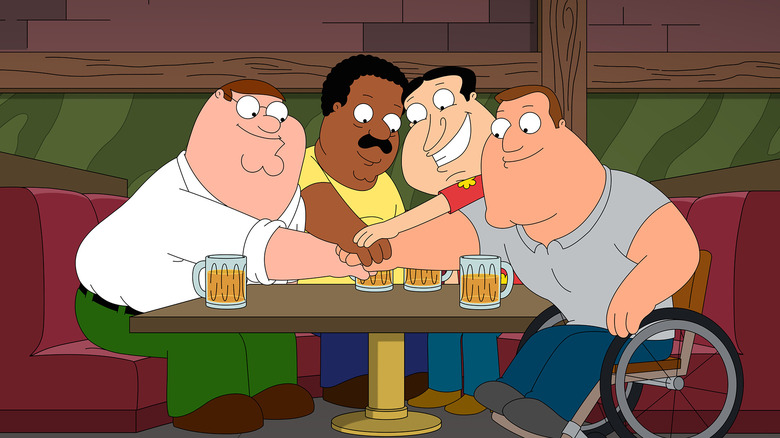
Hank is naive, but he is not dumb. Peter Griffin is truly, incredibly stupid. Even so, both characters are used by their shows to make broader points about society and its extremes. Peter would likely get along with Hank better than he did with Homer Simpson, since Hank is not above keeping a fool like Bill as a best friend.
Their differences also reflect their creators. Mike Judge grew up in Ecuador and later on a chicken farm in New Mexico, studied science in college, and toured with a blues band before turning to animation. Seth MacFarlane, by contrast, loved cartoons from childhood and always wanted to work in animation.
Family Guy takes the familiar cartoon-family template and discards the rules. The dog talks, the baby is a genius supervillain, the town pervert is a recurring joke character, and Peter constantly remembers events that never happened, usually involving pop culture references. The randomness can be jarring if you want a straight story, but it also creates a loose, jazz-like rhythm that works on its own terms.
Enjoyed this article? Sign up for TVLine’s free newsletter, and follow us on Google or add us as a preferred search source for the latest TV, streaming, and movie news.
More from Digilifetrends
10 things people born in the 1980s have nearly forgotten
If you grew up in the 1980s, you probably remember a time before constant screens and online distractions, but after the shift into the digital age began.
2 min read · Updated 2026-10-1272 Vintage Gadgets That Make Yesterday’s Tech Feel Like True Design
Modern electronics have made daily life far easier than it was a few decades ago. Smartphones now do the work of IDs, wallets, music players, and movie players all at once, and…
5 min read · Updated 2026-10-1272 Retro Gadgets That Show Why Old Tech Still Feels So Cool
Modern electronics have made everyday life much easier than it was a couple of decades ago. Smartphones now double as IDs, wallets, and portable players for music and movies,…
6 min read · Updated 2026-10-12