For many people who grew up in the 20th century, Sears was a retail landmark. Established in 1893, the chain spent decades as a familiar anchor in shopping malls, offering everything from clothing and tools to home fitness gear and electronics. At its peak, Sears operated more than 3,500 stores, but by early 2026 only five were still open, a reminder that even the most established companies can fade.
For years, though, Sears remained a major force in electronics sales, reaching customers across the United States and beyond. Several brands became closely tied to the store over time, especially in the radio and television business, which dates back to the earliest days of those technologies. As consumer tech evolved, Sears kept pace by adding newer categories such as home computers.
It was once normal to head to Sears for a home computer. What started as a mail-order catalog business grew into a holiday-shopping giant where the latest gadgets were bought by millions. The following 12 electronics recall the era when Sears dominated the retail landscape.
Silvertone Radio
Among the oldest names linked to Sears was Silvertone, a brand the company used for musical instruments and electronics. From 1915 to 1972, a wide range of products carried the name, but radios were the best-known items. Those radios first appeared in the 1920s, when the technology was becoming central to household life.
Many early radios were housed in large cabinets because vacuum tubes took up so much room. Instead of being hidden away, they were often decorative pieces, built into handsome wooden cases around which families gathered to hear news, music, and radio dramas. As technology moved beyond vacuum tubes, Sears began offering smaller sets, including the one shown here.
That model is a Silvertone transistor radio, model 7228, which began appearing in Sears stores in 1956. It was the first Silvertone transistor radio and sold for $57.95, or about $715 in 2026. Portable and fitted with a handle, it required a special Silvertone 9-volt battery sold by Sears as well. Because Silvertone dated back to the dawn of consumer radio, Sears catalogs trace 57 years of radio technology through the brand.
8-Track Stereo Tape Player
Cassette tapes eventually beat 8-tracks, but the older format stayed popular from the late 1960s until the mid-1980s. Cars were a major part of that popularity, because an 8-track player changed what drivers could hear on the road. Today, music is available digitally, but during the 1970s, a driver without an 8-track player was usually stuck with the radio.
The format was not limited to cars. Sears also sold home 8-track players that looked much like other components in a stereo setup. They could be stacked with a record player or radio and were among the most desirable consumer electronics for several years. Sears added home units like the one shown here in its 1973 Sears Christmas Book.
In the 1970s, an 8-track player usually cost around $45, or about $340 in 2026, depending on the model and features. By then, Silvertone had ended, so many of these players were made by RCA Victor Records, which also produced many 8-track tapes. Even though the format lost to cassettes, 8-track players occupied plenty of shelf space at Sears for more than a decade.
Black & White Portable Television
Sears sold a wide range of consumer electronics, including plenty of televisions. As with many department stores, TVs were often lined up along a wall playing the same image or different demos to show their features. Among the more unusual sets were portable televisions, although by modern standards Sears used the term very loosely because these units were still fairly large.
The black-and-white portable television pictured here is a good example. It may not look especially easy to carry, but it did include a handle that made transport simpler. It did not run on batteries and had to be plugged in. The set used manual tuning dials, including one for switching between VHF and UHF and another for tuning the frequency. On the side were controls for power, volume, contrast, and brightness, plus a headphone jack.
Black-and-white portables remained popular for years, and Sears also sold color televisions. At first, Sears used Silvertone for its TVs, but those were much larger console sets usually built into heavy decorative wooden cabinets, which meant portability was out of the question. Over its history, Sears sold many kinds of televisions, even introducing Kenmore-branded TVs in 2016.
Pong
It may seem unlikely now, but Sears played a major role in helping the video game industry grow during the late 1970s. In 1975, the company reached an agreement with Atari, Inc. to sell home versions of its Pong console in Sears stores. These versions were exclusive to Sears, and shoppers rushed to buy them for the holiday season. Pong itself was simple, offering the same game that had become popular in arcades.
The release mattered because it brought arcade-style gaming into the home. The Magnavox Odyssey had appeared a couple of years earlier, but it could not match Atari’s Pong, especially in the consumer electronics market. By stocking Pong, Sears helped prove the commercial value of home video games, and many imitators soon followed.
Sears first sold the unusual-looking Pong systems under its Tele-Games label. Their success helped secure Atari’s position in the market, and the later arrival of the Atari Video Computer System, or VCS, later renamed the Atari 2600, further strengthened the industry in North America. In that sense, Sears helped lay the foundation for the home video game market.
Tele-Games Video Arcade
When Atari introduced the Atari VCS in 1977, it launched one of the most important consoles ever released. It was not the first system with interchangeable games; that distinction belonged to the 1976 Fairchild Channel F. Still, the Atari VCS quickly eclipsed it and came to dominate the home video game market. Sears was part of that success story.
Rather than sell the Atari console under its original name, Sears rebranded it as the Tele-Games Video Arcade, following the approach it had used with Pong. The Tele-Games version had some minor cosmetic differences, but it was otherwise the same machine. It used the same games, switches, and controllers and was manufactured by Atari just like the standard version.
Because Sears sold a slightly different-looking model, some shoppers did not immediately realize it was the same console available elsewhere. The branding also extended to the games, which carried the Tele-Games name on the packaging. The exact number sold through Sears is unclear, but Atari ultimately sold 30 million consoles over the system’s life.
Electronic Football
In 1977, Mattel Electronics introduced Football, a handheld game that used red LEDs to mimic play on the field. It became extremely popular and has since been revived in modern form, inspiring many imitators in its prime. Sears sold Football and another game, Auto Race, initially ordering fewer than 100,000 units because it expected weak demand. That estimate was badly wrong, and after production resumed, Sears was selling as many as 500,000 units a week by February 1978.
As with other hit electronics of the era, success brought copycats, and electronic football games from many manufacturers soon appeared. Sears kept selling them, including the two-player version shown here, which features the Sears name opposite the words Electronic Football. Sears began carrying this device in 1980, and it sold well, becoming a familiar early-1980s item tied to the company.
The company’s first electronic football game was a rebranded version of Coleco’s Electronic Quarterback, sold as Electronic Touchdown. Whatever the name, the basic gameplay stayed the same: LEDs and a few buttons handled everything. Long before Tiger Electronics LCD handhelds became common, Sears’ Electronic Football was one of the most popular portable games around.
Tele-Game Super Video Arcade Cartridge System
Sears’ habit of rebranding other companies’ game systems was not limited to Atari. The company also did it with Mattel Electronics’ Intellivision. Released in 1979, the Intellivision carved out its own place in the market against Atari’s machines, and Sears helped by selling it under the Tele-Games Super Video Arcade Cartridge System name. The title was a mouthful, and like the Tele-Games Video Arcade, it was not a complete copy.
The console had some cosmetic differences, but the changes went beyond appearance. Sears’ version used non-coiled wired controllers that were fixed in a forward-facing position, making them easier to manage. Even though the Intellivision was infamous for its awkward controllers, the Sears version made modest improvements.
Atari and Mattel battled for control of the early console market, a conflict that did not formally end until 2024, when Atari purchased Intellivision and some of its games. During their rivalry, Sears helped move as many Tele-Games Super Video Arcade Cartridge Systems as it could, while Atari ultimately sold more than Intellivision’s 3 million units.
LXI Series 2960 Mini Bookshelf System
One of Sears’ best-known house brands in the 1980s and 1990s was LXI, which replaced Silvertone across many types of electronics. The label covered boomboxes, televisions, and stereo systems, and it took up a large amount of shelf space in Sears stores before the end of the century. LXI stereo systems often included stackable components and large speakers.
These systems became a familiar sight beginning in 1979 with the Sears Christmas Book, and by 1996 the LXI name had disappeared from Sears catalogs. The brand was especially associated with stereo equipment, but by the late 1990s such systems were getting smaller and less central to home entertainment. Even so, LXI remained one of the house brands most closely tied to Sears.
A typical LXI system included an amplifier, some kind of cassette deck, and a tuner connected to large speakers. Most used two speakers for stereo sound, though buyers could choose components individually and set them up however they liked at home. They were not cheap, but they delivered strong sound and were highly appealing throughout the 1980s.
Commodore 64
Released in 1982, the Commodore 64 quickly became one of the fastest-selling home computers ever made. It earned a Guinness World Record as the best-selling desktop computer, moving more than 12.5 million units between August 1982 and April 1994. With its large game library, ease of use, and home-friendly features, it became a defining computer of the early 1980s.
Home computers were still new in 1982, but one reason many people began imagining them in their homes was seeing the Commodore 64 on display at Sears. Sears was not the only retailer to carry it, but it helped popularize the machine. The exact number Sears sold is unclear, though the system had reached around 20 million sales by the early 1990s.
Although the Commodore 64 debuted at $595, or about $2,065 in 2026, the price dropped to $250 the following year, making it far more affordable. By 1985, Sears was offering it for just $149.99, or about $470 in 2026. That lower price helped drive demand even further.
Macintosh 128K
Apple is now best known for the iPhone and iPad, but the company first made its name with home computers. After the Apple-1 in 1976 came several later models, including the Macintosh 128K shown here. Although it was not Apple’s first computer, it is the model most people associate with the company’s early years. It was also the first successful mass-market computer with a built-in screen, which helped make it so recognizable.
Sears sold Apple computers through its Business Systems Centers, including the Macintosh 128K alongside competing brands. It also carried several other Apple models, including some of the company’s more unusual Macintosh computers. Sears began selling the Macintosh 128K in 1984, and it soon became one of the best-selling computers of its era, ending up in homes, schools, and businesses around the world.
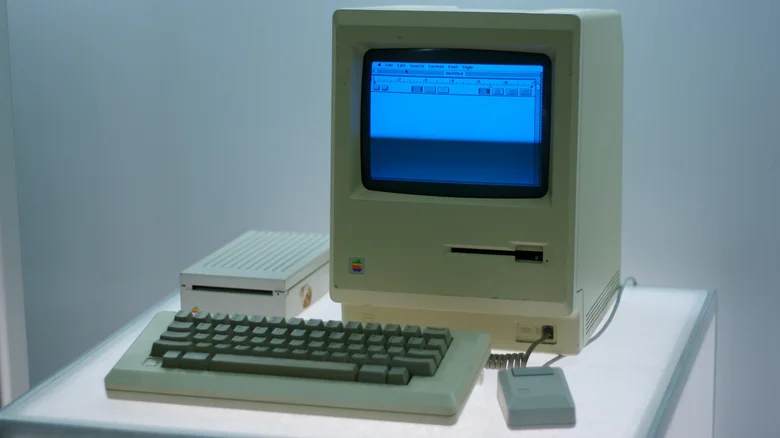
By modern standards, the Macintosh 128K looks primitive, but it was significant as the first Apple product to feature a graphical user interface. That made it much easier for ordinary buyers to use without programming knowledge. It launched at $2,500, or about $8,060 in 2026, so it was expensive, but it was also powerful for its time and gained huge attention after Apple’s famous Super Bowl XVIII ad.
VTech Laser 128
Along with Apple’s own computers, Sears also sold clones. Unlike the earlier licensed rebrands of the Atari VCS and Intellivision, however, the VTech Laser 128 was not made through an agreement with Apple. It copied the Apple IIc, one of Apple’s earlier systems, while Sears advertised it as a cheaper alternative that was still fully compatible with Apple software.
The machine was designed to resemble the Apple IIc, including 128 KB of RAM, the same amount found in Apple’s model. It also had a handle, a disk drive on the right side, and a built-in CPU and keyboard. Because it could run anything the Apple IIc could, the resemblance was more than skin deep.
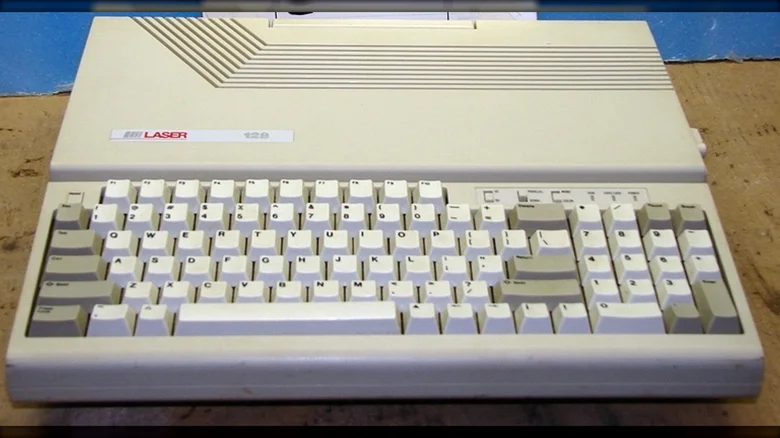
Even so, Video Technologies Ltd. did not infringe Apple’s copyrights in the way it built the machine, so the clone stayed on the market as direct competition. According to Old-Computers.com, the VTech Laser 128 was 99.8% compatible with the Apple IIc and became the most successful of its clones. Sears sold it well, helped by a price of $479, compared with $1,300 for the Apple IIc.
Pokémon Pikachu
By the late 1990s, Sears was carrying all kinds of electronics, including many that were not exclusive to the company or its house brands. One of the more entertaining items shoppers could find was Pokémon Pikachu, a small device that worked like a Tamagotchi-style digital pet and pedometer. It appeared in the 1999 Sears Christmas Book for $29.99, or about $60 in 2026.
The toy was promoted as a playful accessory and a virtual pet you could take along on walks. Its built-in pedometer tracked how far you moved, and the more you walked, the friendlier Pikachu became. In that way, it encouraged people to get outside and interact with their favorite Pokémon, much like Pokémon Go would do years later.
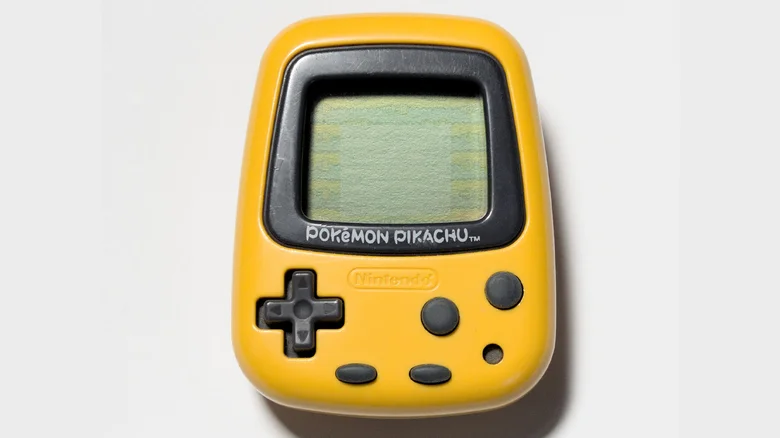
Unlike many virtual pets of the era, Pikachu did not need to be fed, watered, or cleaned. Walking was all that was required. As you moved around, you earned watts to spend on gifts for Pikachu. More activities unlocked the longer you used it, and if you ignored him, he would stop recognizing you, making it a playful and interactive gadget.
More from Digilifetrends
10 things people born in the 1980s have nearly forgotten
If you grew up in the 1980s, you probably remember a time before constant screens and online distractions, but after the shift into the digital age began.
2 min read · Updated 2026-10-1272 Vintage Gadgets That Make Yesterday’s Tech Feel Like True Design
Modern electronics have made daily life far easier than it was a few decades ago. Smartphones now do the work of IDs, wallets, music players, and movie players all at once, and…
5 min read · Updated 2026-10-1272 Retro Gadgets That Show Why Old Tech Still Feels So Cool
Modern electronics have made everyday life much easier than it was a couple of decades ago. Smartphones now double as IDs, wallets, and portable players for music and movies,…
6 min read · Updated 2026-10-12